As that role changes, the effects travel well beyond Japan's borders, into Treasury markets, equity markets and, ultimately, the cost of money here in Australia.
Why it is happening
To understand why this shift matters, start with what Japan has been to the global financial system for thirty years: its largest and most reliable lender.
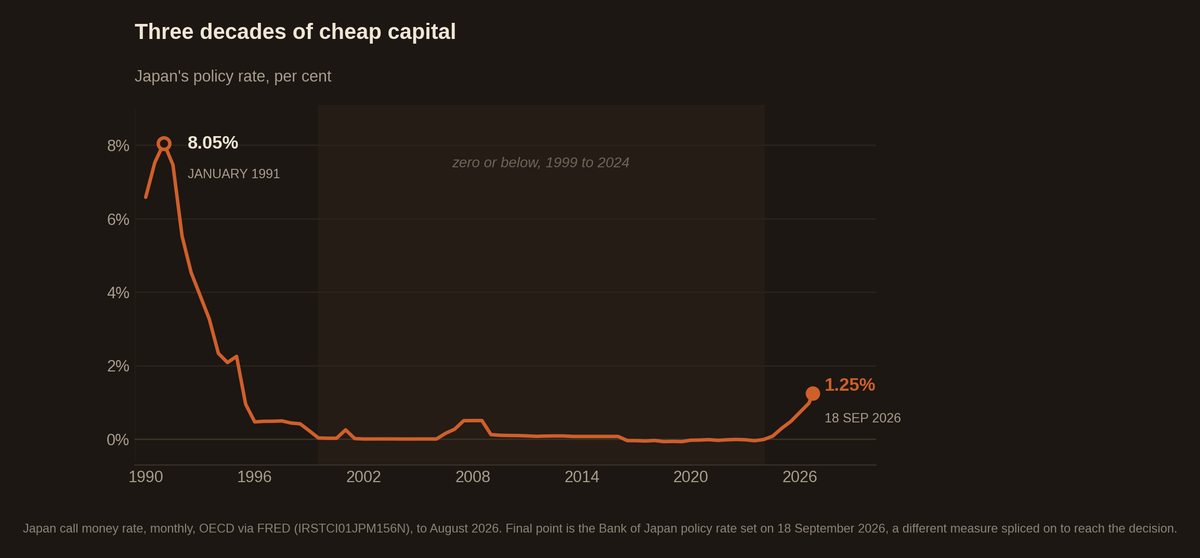
After its asset bubble burst in 1990, Japan entered a long period of weak growth and falling prices. The Bank of Japan responded by cutting rates to zero by 1999 and later pushed them below zero while buying its own government's bonds on an enormous scale. For a Japanese pension fund, insurer or household, that left almost nothing to earn at home, thus shifting capital offshore.
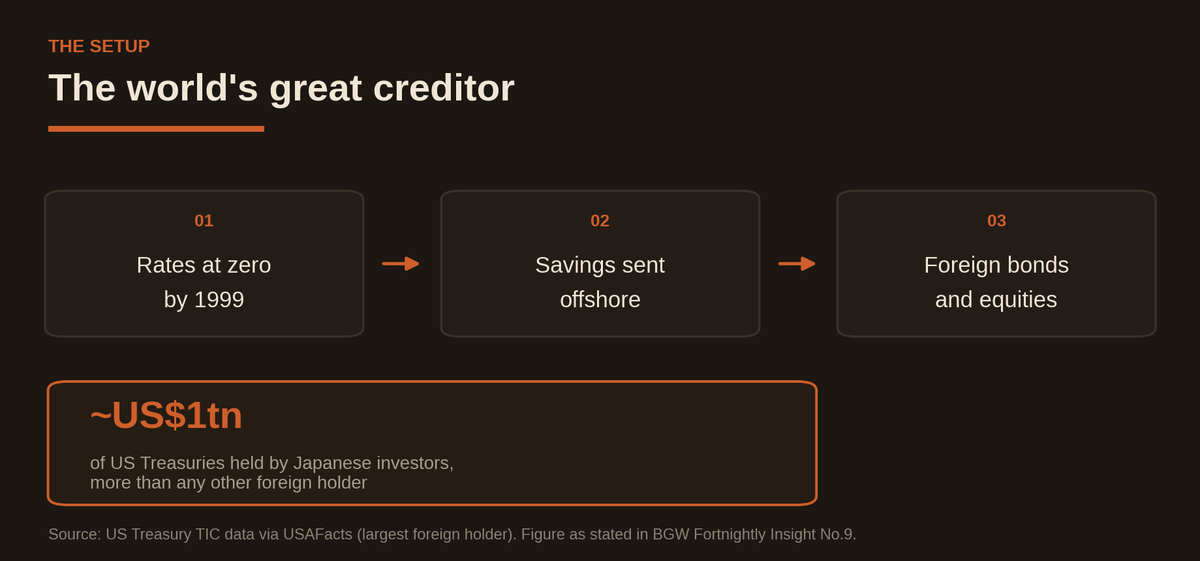
Over three decades, Japan became the world's great creditor nation, recycling a large domestic savings pool into foreign bonds and equities. The clearest expression of this is the US Treasury market, where Japanese investors hold roughly US$1 trillion, more than any other foreign holder.
This matters because of what kind of buyer Japan was. Its institutions bought steadily, for the long term, and were largely indifferent to price because the alternative investment return domestically was zero. A buyer like that holds long-dated yields down for everyone. In effect, part of the low cost of borrowing enjoyed by governments and companies worldwide has been subsidised by the low domestic Japanese bond yields.
The carry trade
Cheap yen also created the yen carry trade. The structure needs two conditions to hold at once: low-cost yen funding and a stable, weak exchange rate. Institutional and leveraged investors borrow in yen at Japan's policy rate, convert the proceeds into higher-yielding currencies, and invest in US equities, emerging-market debt and other carry-sensitive assets.
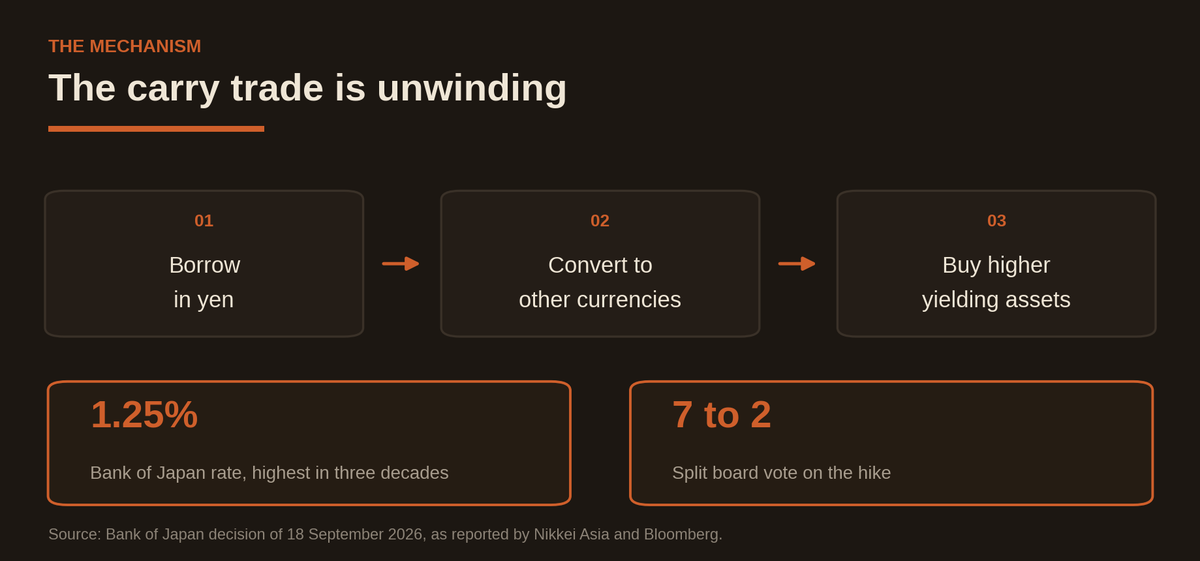
When either condition fails, the economics flip. A higher Japanese rate or a stronger yen raises the cost of servicing the debt in yen terms, so leveraged investors close positions and bring capital home. That selling can spill into assets with no direct connection to Japan. It is why a single Bank of Japan decision can move prices in New York or Sydney within hours, and why every force now pushing the yen higher works against the trade.
The carry trade has been unwinding in real time. In the weeks before September's meeting, the yen rallied from around 160 to below 153 against the US dollar as leveraged positions were closed ahead of an expected hike. The Bank of Japan delivered, but a seven-to-two board split and a cautious statement from Governor Kazuo Ueda disappointed markets. The yen drifted back above 157, weaker than policymakers in Tokyo and Washington would like.
The market's read was mixed. Others focused on the constraints still facing the Bank. Commonwealth Bank of Australia's Carol Kong noted that the two dissenting votes came from board members appointed by Prime Minister Takaichi, saying this suggests "the government still leans against BOJ rate hikes." HSBC's Fred Neumann said the tone of the statement, "along with two dissenters on the decision to raise rates, leaves lingering doubts."
The next test is the Bank's meeting on 29 and 30 October, which comes with a fresh quarterly Outlook Report.
Why Washington bought yen
Washington has not been a bystander. At the start of August, the US Treasury joined Japan's Ministry of Finance in buying yen, an unusual step for a country that rarely intervenes on behalf of another currency. The Official Monetary and Financial Institutions Forum estimates Japan's intervention at around US$75 billion and the US contribution at roughly US$5 billion to US$10 billion. The US leg was funded in euros rather than dollars, which analysts read as an effort to avoid selling US Treasuries. Unlike the joint interventions of 2000 and 2011, the Federal Reserve did not take part, and the G7 did not coordinate the action.
That buying pressure works in the same direction as September's rate hike. Both push the yen higher, which raises the cost of yen-funded positions and adds to the pressure on the carry trade rather than offsetting it.
Treasury Secretary Scott Bessent has kept up the pressure verbally, pushing for an expansion of the Fed's FIMA repo facility, which Japan would use to fund future intervention without selling its Treasury holdings. Bloomberg has warned that this jawboning risks raising expectations the Bank of Japan cannot meet. Washington's message to Tokyo is clear: it wants a stronger yen, delivered through Japanese policy rather than through sales of US government debt.
What it means for Australia
Australia is a small, open capital market, and the pressure building offshore reaches local markets through three channels.
The bond market. Australian long-term yields are set largely by global forces. As US yields rose after the Federal Reserve's hike, Australia's ten-year followed, trading above 5.3 per cent, near its highest since 2011. On 10 September the thirty-year reached a record 5.65 per cent. Higher long-term yields raise the discount rate applied to every future cash flow, so the assets valued most on distant earnings reprice first.
The currency. The Australian dollar has long been a favoured destination for yen-funded carry trades. As tighter Japanese policy and official yen buying raise the cost of that funding, those positions become more expensive to hold, and unwinding them adds selling pressure on Australian assets unrelated to local fundamentals. That can push up the cost of capital for Australian companies at the same time as demand softens: figures released on Thursday showed unemployment rose to 4.6 per cent in August, weighing on the household spending many businesses rely on.
Equities. All three pressures have shown up on the ASX. On 10 September the ASX 200 had its worst session since March, erasing around $50 billion in value. On 24 September it slipped back into negative territory for the year, the tenth time it has done so in 2026. The losses have not been even. Property, the sector most sensitive to bond yields, has led the declines, and the major banks and miners have also come under pressure.
How I think about it
Periods like this provide opportunities for diversification and risk management. If you would like to review how your portfolio is positioned for a higher global cost of capital, and which private and public market opportunities fit the circumstances, that is a conversation sized to each client's circumstances and wholesale eligibility rather than a product. If you would like to see where the broader market sits today, the Australia Market Valuation dashboard is updated regularly.