What makes this significant is the timing: Australia, where more household wealth sits in housing than almost anywhere in the developed world, is now undergoing the same rotation. It is being driven by the biggest property tax reset in a generation, and home values have fallen for six consecutive months (UBS).
The capital rotation
UBS’s 2026 Global Family Office Report surveyed 307 family offices with an average net worth of US$2.7 billion. Less than half of their wealth sits in listed shares and property combined. The rest is spread across private equity, bonds, private credit, hedge funds, cash and gold.
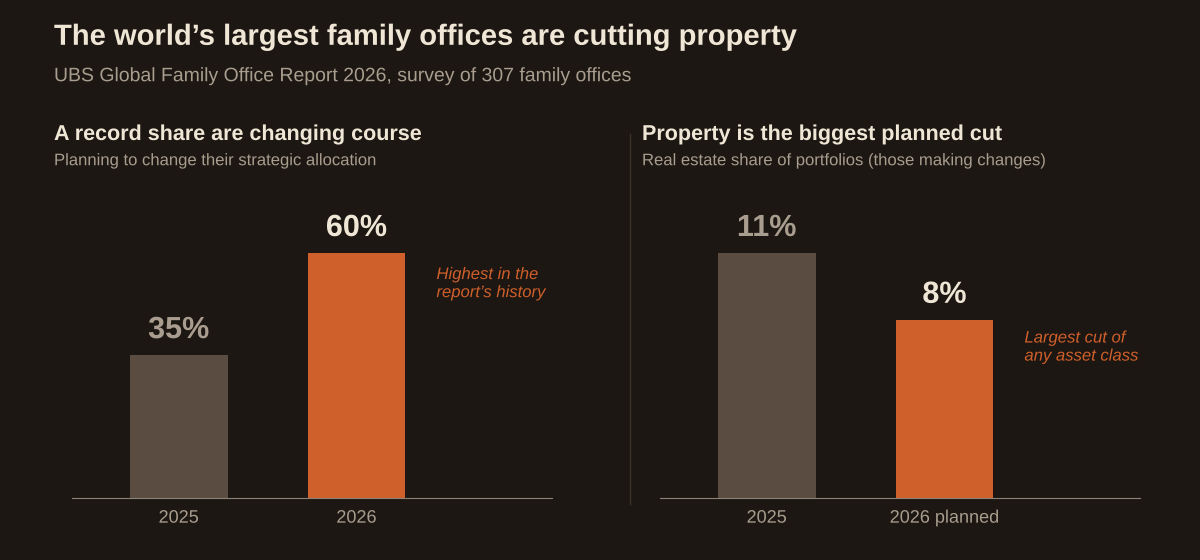
That mix is now shifting again. Sixty per cent of family offices plan to adjust their strategic allocation over the next twelve months, up from 35 per cent a year ago and the highest share in the report’s history. Among those making changes, real estate is expected to fall from 11 per cent to 8 per cent of portfolios, the largest planned reduction of any asset class. Capital is moving toward infrastructure, emerging market equities and gold.

“Australia’s real estate markets have been a multigenerational wealth creator, finely tuned and regulated to withstand global short term shocks that influence interest rates, exchange rates and social changes.”
What’s different now
“We are creating new ways to invest, new global banking guard rails and new asset classes. We have new ways to create generational wealth, and they are easier and cheaper to access than real estate.”
“Globally, capital regulation and Taxation are changing, as is the global status of the USA while geopolitical conflicts have been weaponised by new global technology. Together they have created fear, fear of the unknown.”
“Fear creates indecision, and our real estate markets are gripped by fear.”
What is happening in Australian property
The slowdown that began in autumn has become a broad correction. National home values fell 1.1 per cent in September, the sixth consecutive monthly decline, leaving prices 5.2 per cent below their March peak. Sydney values are 7 per cent lower than a year ago and Melbourne 6.2 per cent lower. Brisbane, Adelaide and Perth all fell more than 1 per cent in the month.
Source: Cotality Home Value Index, 1 October 2026.
The breadth is the notable part. 97 per cent of capital city suburbs lost value over the September quarter. Sales volumes are running almost a fifth below last year, while advertised stock in the capitals is up 23 per cent. The typical home now takes 39 days to sell, against 23 a year ago (Cotality). In the weeks after the Budget, weekend auction clearance rates fell below 50 per cent, the weakest since the pandemic (Reuters).
The shift is now visible in the national accounts. In the June quarter, the value of Australia’s land and dwellings fell for the first time since 2022. Household wealth still rose, because superannuation, lifted by share markets, offset the decline (ABS). For a country that keeps more than half its household wealth in housing, that is a meaningful change in where wealth is being created.
Why it is happening
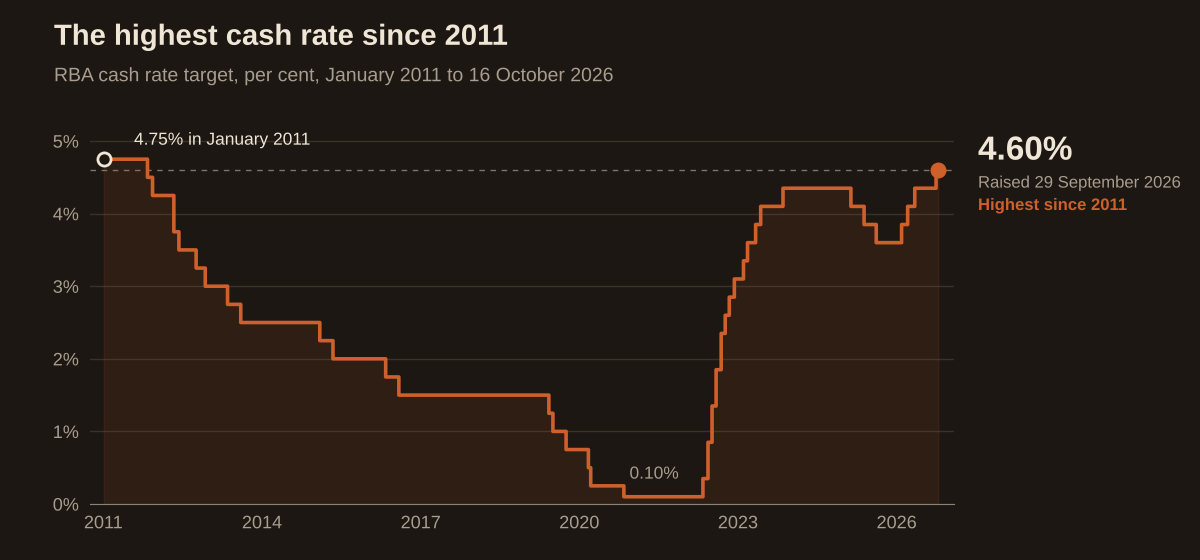
The cost of money. The Reserve Bank lifted the cash rate to 4.60 per cent on 29 September, its fourth increase this year and the highest setting since 2011. Property is the asset class most sensitive to borrowing costs, and leveraged investors feel it first. Thin rental yields now struggle to cover funding costs that were manageable two years ago.
The tax reset. The May Budget delivered the biggest change to property taxation since 1999. From 1 July 2027, the 50 per cent capital gains discount is replaced by inflation indexation and a 30 per cent minimum tax on gains. The change applies to assets held by individuals, trusts and partnerships, shares included, with one exception: new residential builds (Accountants Daily). Gains accrued before July 2027 keep the old discount, and negative gearing is fully grandfathered for properties held before Budget night. For anyone buying an established home from here, rental losses will offset only property income, not wages.
The repayment squeeze. Repayments on a median-priced home now take 35.5 per cent of average household income, the highest share since 1989 and above the 33.3 per cent peak reached during the global financial crisis (REA Group, Housing Affordability Report FY26). REA estimates that one more rate rise, taking the cash rate to 4.85 per cent, would lift that share to 37.4 per cent, just short of the record 37.5 per cent set in December 1989 (The Adviser).
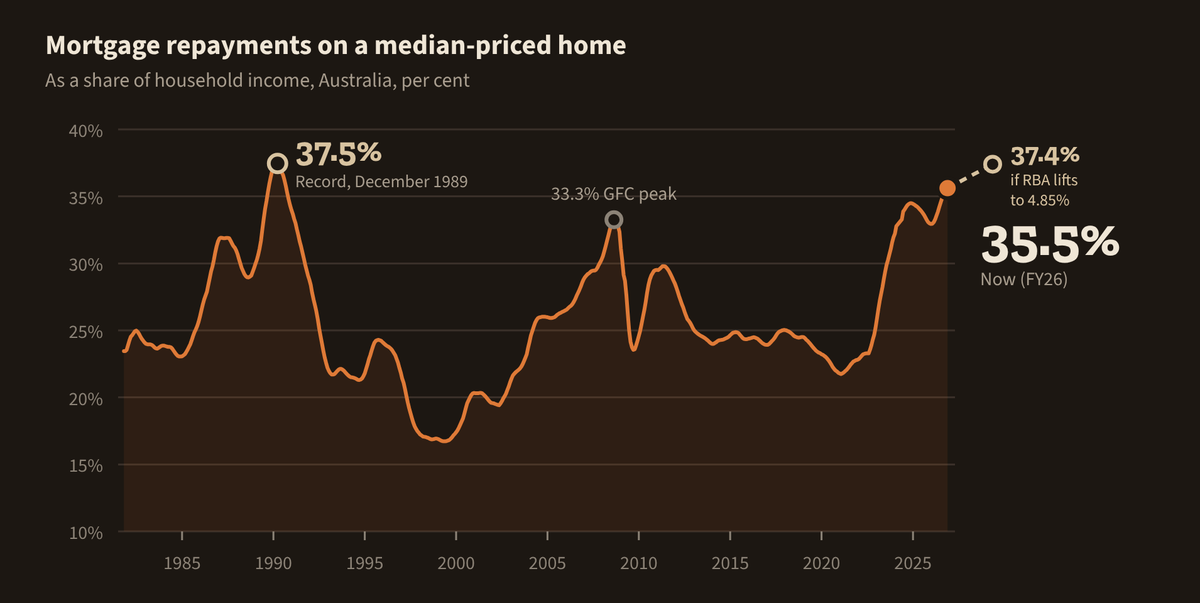
What stands out is that this is happening with mortgage rates at about half their 1989 level. The banks’ standard variable rate for owner-occupiers was 17.0 per cent in December 1989 and 8.77 per cent in September 2026 (RBA, statistical table F5). Most borrowers pay less than the standard rate, but the comparison holds on either measure. Repayments take almost the same share of income at half the interest rate because loans are now far larger relative to incomes than they were in 1989.
What it means for investors
This is not a collapse. Grandfathering gives existing investors every reason to hold, which limits forced selling. Commonwealth Bank’s economists expect a one-off adjustment to prices rather than a lasting break, noting that “the tax changes have accelerated a slowdown that was already underway” (CBA).
Many of the strategies family offices use sit in private markets, with high minimums and limited access. Boston Global Wealth exists to close that gap. We give clients access to sophisticated and exclusive investment strategies across asset classes, selected to provide growth, diversification and disciplined risk management within a single, coherent portfolio.
Residential property still has a place in that mix, but in a different form. New supply keeps the tax settings that established homes are losing. Westpac expects rental yields to rise as investors price in lower after-tax returns, and rental housing to concentrate in larger, professionally managed portfolios. Australia’s first build-to-rent index returned 8.7 per cent in the year to June (MSCI). For investors who want to keep bricks and mortar in their portfolio, income-generating residential projects offer that exposure without relying on capital growth alone.
Periods like this reward investors who review their exposure deliberately rather than by default. If you would like to understand how your portfolio is positioned for the new tax settings, and which opportunities across our platform fit your circumstances, I can take you through it. If you would like to see where the broader share market sits today, the Australia Market Valuation dashboard is updated regularly.