Behavioural finance is easy to agree with and hard to apply. Knowing that a bias exists does not stop it working on you. So rather than describe these biases in the abstract, I have tested each one against my own decisions. Every story below is mine, and every figure traces back to the original research.
1. Money you’re handed doesn’t stay.The house money effect
My story
My father won Oz Lotto when I was about six. He died bankrupt.
He won roughly $250,000 on Saturday Oz Lotto. My family bought a house, sold it, and moved more than once. Later he bought a food processing business that was only ever registered as a cafe. A neighbour complained, the council made him move it, and it ruined him.
What I took from it: money you are handed, but have not learned to make, does not stay.
The research
Thaler and Johnson (1990) called it the house money effect: after a gain, people take more risk, because it does not feel like their own money.
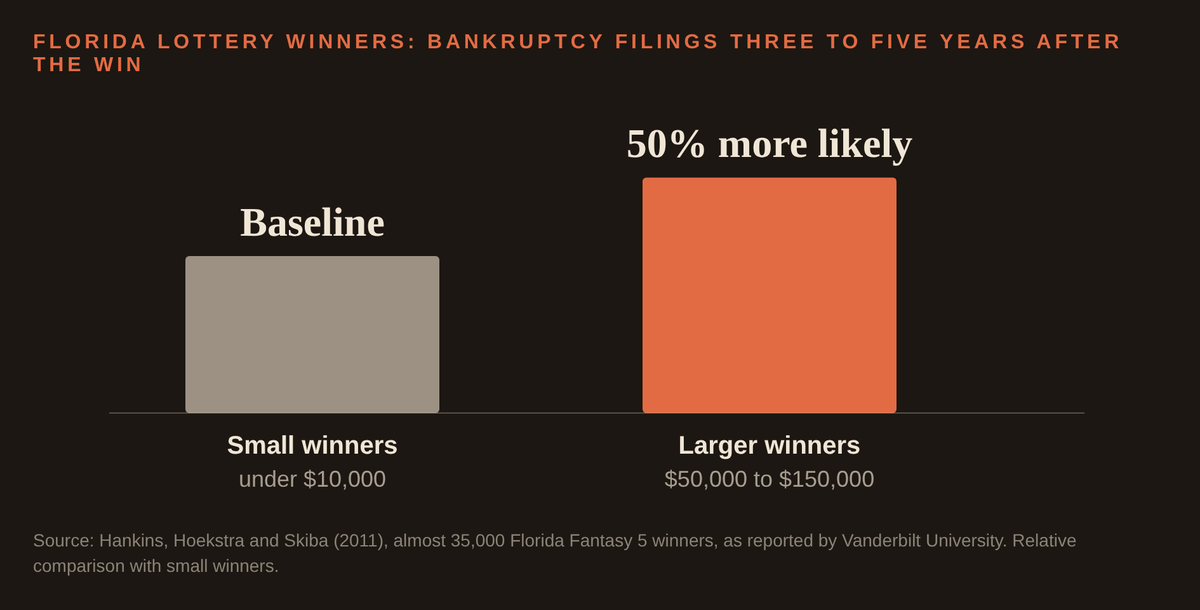
A study of almost 35,000 Florida lottery winners found that people who won $50,000 to $150,000 were less likely to go bankrupt straight away, but 50% more likely to file three to five years later than small winners. Over five years, the big win did not lower their bankruptcy rate.
What I do now
A bonus, an inheritance, the proceeds of a sale: any lump sum waits before it is spent, and gets the same scrutiny as money earned the hard way.
And before buying any business, check what it is actually registered and approved to do.
Hankins, S., Hoekstra, M. and Skiba, P. M. (2011). “The Ticket to Easy Street? The Financial Consequences of Winning the Lottery.” Review of Economics and Statistics, 93(3), 961-969; figures as reported by Vanderbilt University (2009).
2. Sell the winner. Hold the loser.The disposition effect
My story
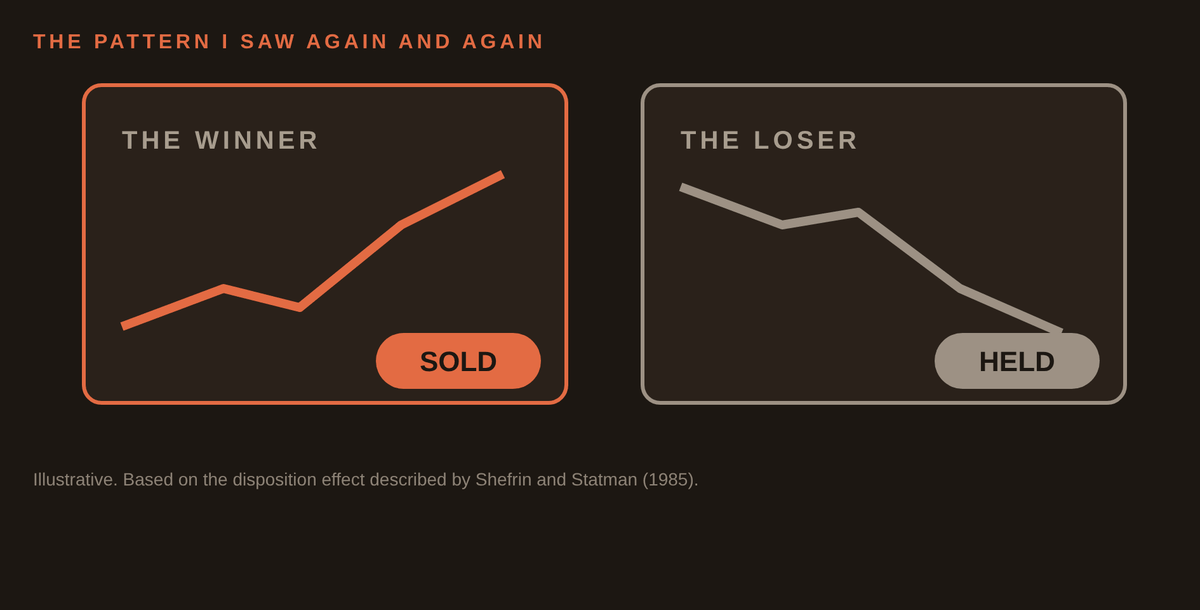
Between 2020 and about 2023 I was broking through COVID. Over and over, I watched clients sell what had gone up and hold on to what had gone down. I would point out the pattern. Wholesale clients make the final call, and most of the time they held on.
I am not immune. My rule is to trim anything above about 10% of a portfolio. It once got me out of a stock within three days, before it went to nothing. It is also why I take profits earlier than I should.
The research
Shefrin and Statman (1985) named it the disposition effect: selling winners too early and riding losers too long.
Odean (1998) found it in the records of a US discount broker from 1987 to 1993. Investors realised gains at a much higher rate than losses, and what happened next did not justify it.
Prospect theory explains why: the purchase price becomes the reference point, and people take more risk rather than lock in a loss.
What I do now
Every position gets judged on what it is likely to do from here, not on what I paid.
Before I buy, I write down what would tell me I am wrong. The purchase price is not on that list.
Odean, T. (1998). “Are Investors Reluctant to Realize Their Losses?” Journal of Finance, 53(5), 1775-1798.
Kahneman, D. and Tversky, A. (1979). “Prospect Theory: An Analysis of Decision under Risk.” Econometrica, 47(2), 263-291.
3. “When’s the close date?”Scarcity and narrow bracketing
My story
It is the question that worries me most.
Private deals in my world often close within a couple of weeks, and plenty are oversubscribed. One client in his fifties asks the same question about every deal: “When’s the close date? I need to get in before that date.”
It comes before the questions that matter. How much of what I own is already in deals like this? Could I wait years to get this money back?
The research
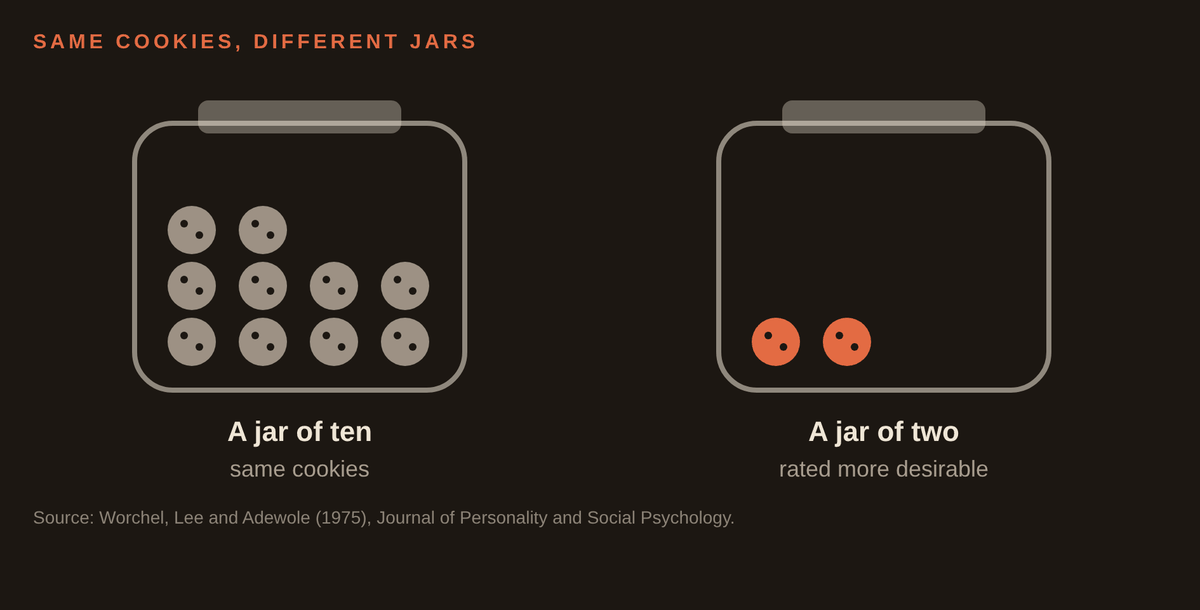
In a 1975 experiment, one group got a jar of ten cookies and another a jar of two. The cookies in the jar of two were rated more desirable, and people who watched a jar of ten drop to two rated them the most desirable of all.
Add a deadline and each deal gets judged on its own, not against everything else you own. Researchers call that narrow bracketing.
What I do now
The right amount for private deals gets decided when nothing is closing: a limit for any single deal, and a limit for private assets overall.
When an offer arrives, the only question is whether it fits inside the limit. I would rather a client miss a deal than own too much of one.
Read, D., Loewenstein, G. and Rabin, M. (1999). “Choice Bracketing.” Journal of Risk and Uncertainty, 19, 171-197.
4. I own what I know. Almost all of it.Familiarity bias
My story
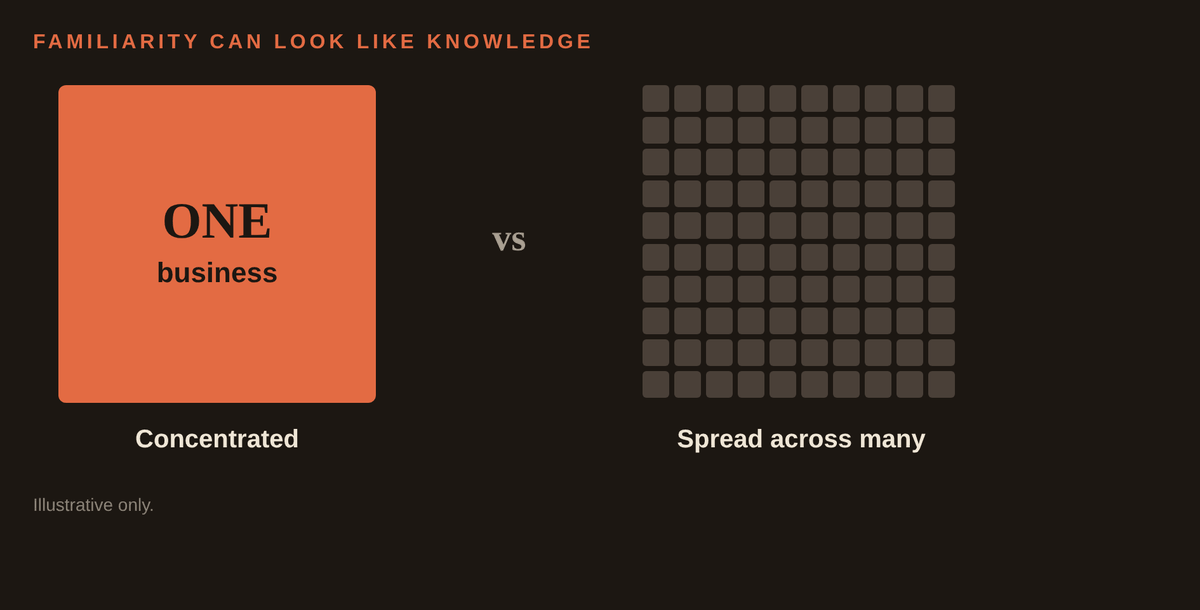
My income, my wealth and my retirement plan all sit in one asset: the practice I built.
When I sold a property at a good profit, I put the proceeds straight back into it.
The reason I gave myself: I control this business in a way I never could a listed company. I had never once tested that concentration against an alternative.
The research
Huberman (2001) found investors favour companies they know, like their local phone company, with no information advantage.
Moskowitz and Vissing-Jørgensen (2002) found entrepreneurial investment is extremely concentrated, yet the returns to private equity are no higher than the returns to public equity.
And the feeling of control is a known distortion of its own (Langer, 1975).
What I do now
A business I run is not the same as a share I happen to own, and effort does change the result.
But I have committed to reviewing that concentration once a year, with someone outside the business.
Moskowitz, T. J. and Vissing-Jørgensen, A. (2002). “The Returns to Entrepreneurial Investment: A Private Equity Premium Puzzle?” American Economic Review, 92(4), 745-778.
Langer, E. J. (1975). “The Illusion of Control.” Journal of Personality and Social Psychology, 32(2), 311-328.
5. Her money. My money. Same account.Mental accounting
My story
Before a family trip to the Philippines, my wife and I started keeping score.
Costs got pushed across the table. Purchases got put off.
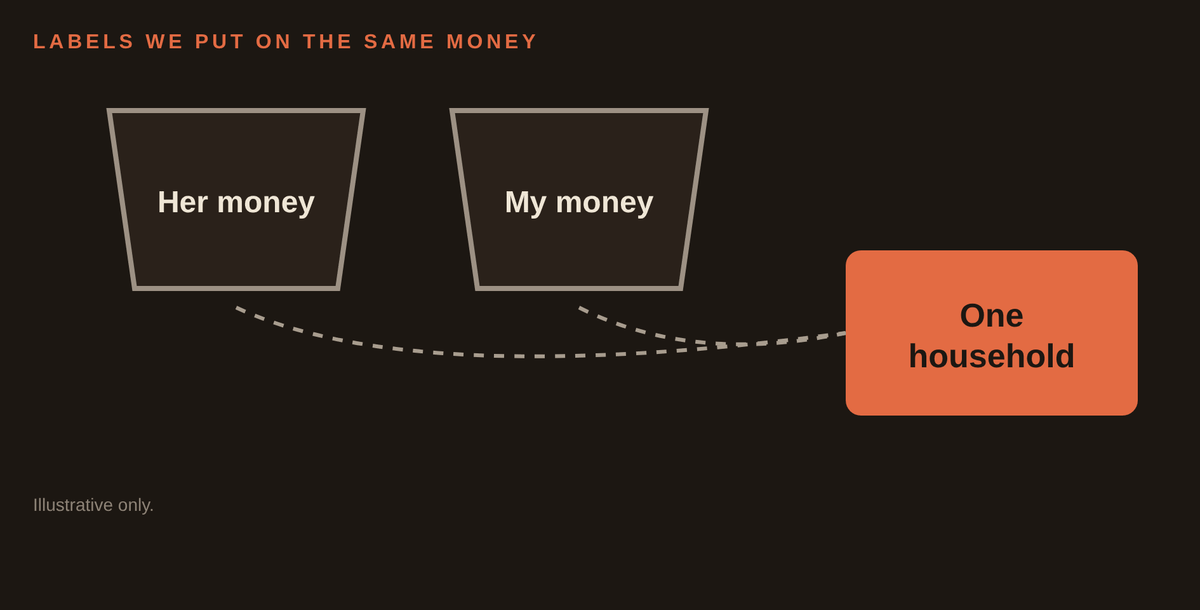
The money was already joint. Whoever paid, it came out of the same place. The labels changed what we bought, not just who paid.
The research
Thaler (1999) called it mental accounting: we sort money into separate accounts by where it came from or what it is for, so a dollar stops being a dollar.
Olson and colleagues (2023) randomly assigned 230 couples over 24 months. Those given a joint account avoided the usual decline in relationship quality.
What I do now
Everything is reported in one place, so the surplus is visible whoever’s name is on the account.
Separate accounts are not automatically wrong. The problem starts when the label, not the plan, decides what you do.
Olson, J. G., Rick, S. I., Small, D. A. and Finkel, E. J. (2023). “Common Cents: Bank Account Structure and Couples’ Relationship Dynamics.” Journal of Consumer Research, 50(4), 704-721.
6. Easy to see in others. Hard to see in myself.The bias blind spot
My story
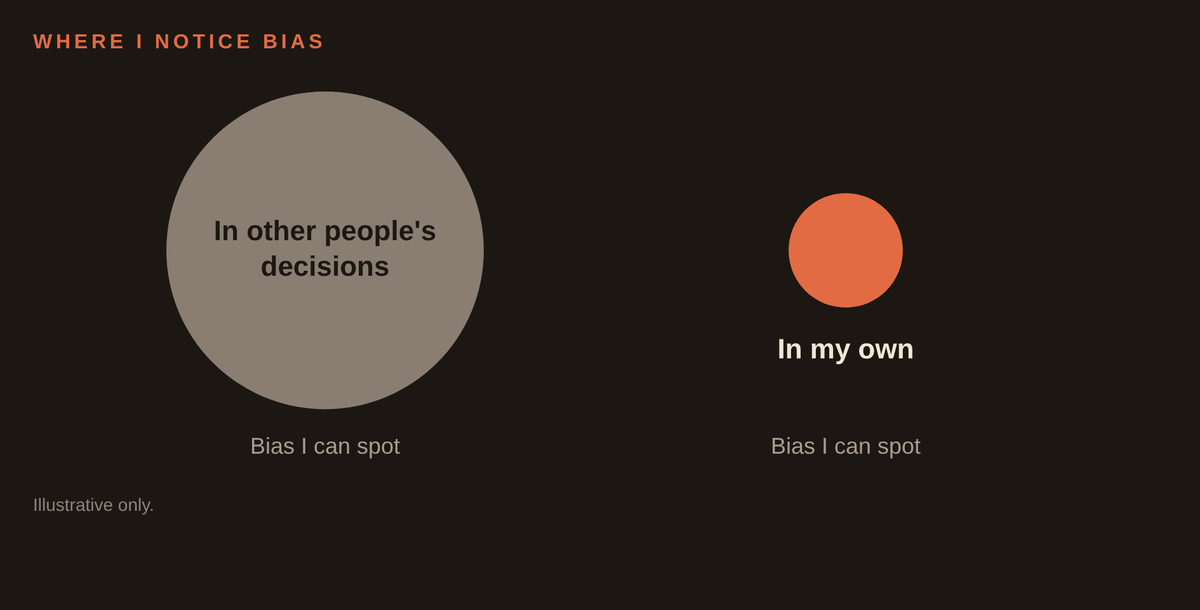
I spend my working life pointing out biases in other people’s decisions. When I tested the same theory against my own money, I found the same patterns: winners sold early, money kept in separate buckets, almost everything in one asset I feel I control. I tell clients to let winners run. I don’t always.
Knowing the theory did not stop me. I even tried mechanical stop losses. They failed, because a price trigger cannot tell ordinary volatility from a broken thesis.
The research
Pronin, Lin and Ross (2002) described the bias blind spot: people see the effect of bias in other people’s judgement far more readily than in their own.
The encouraging part: Morewedge and colleagues (2015) found a single training intervention reduced biased decisions, and the effect lasted.
What I do now
A one page decision journal, written before I act: the thesis, the numbers, what would tell me I am wrong, and when I will review it.
And I have committed to running the process I apply to client portfolios over my own, once a year.
Morewedge, C. K. et al. (2015). “Debiasing Decisions: Improved Decision Making With a Single Training Intervention.” Policy Insights from the Behavioral and Brain Sciences, 2(1), 129-140.
What this series is, and what it is not
These are my own experiences and the research I find useful. They describe the past, they are not a prediction, and none of it is a recommendation about any particular investment. What it does is change the questions worth asking before a decision, not after it. If you would like to see the studies behind my other posts, the research library sets them out with the original sources.